
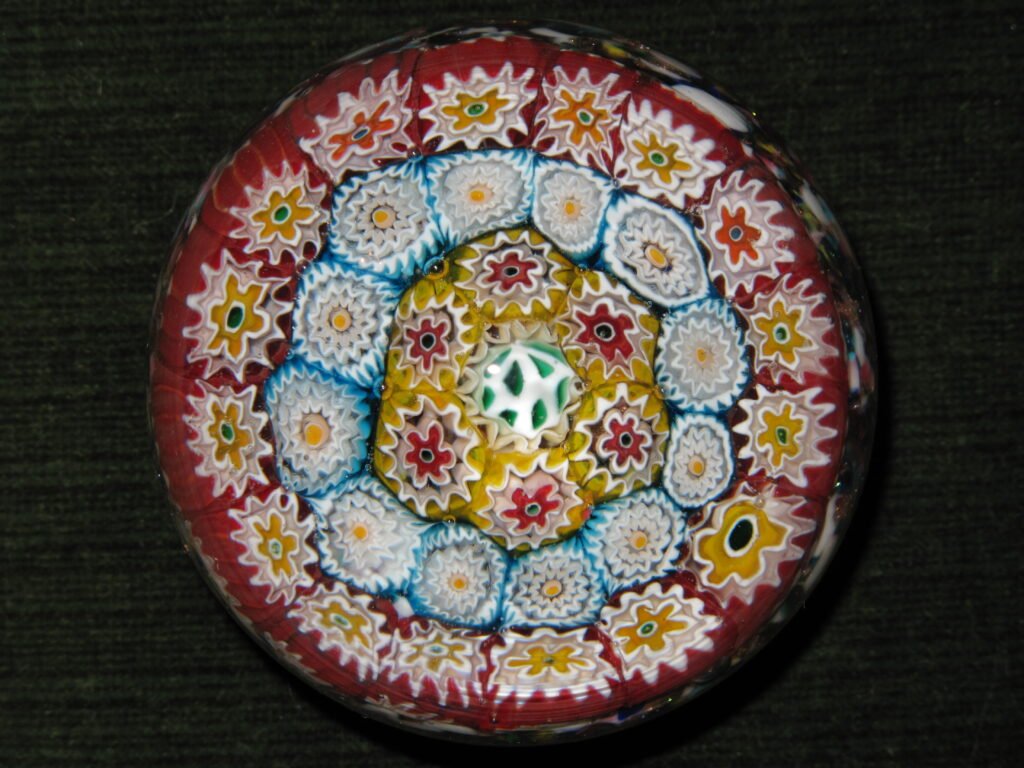
Millefiori is Italian for a thousand flowers, and the name describes the effect rather than the method. The technique long predates the paperweight (it was in use around two thousand years ago) and was revived in the nineteenth century.
What a cane is
A cane is a rod of glass assembled in layers, then drawn out until its cross-section is a few millimetres across. Whatever pattern was built into the thick end survives the stretching, reduced in scale. Cut the drawn rod into slices and every slice carries the same design.
Why the dome matters
The clear glass over the setup is not a cover. It is a lens, and the maker knew it. Arrangements were composed to be read through that magnification, which is why a weight photographed flat and a weight in the hand can look like different objects.
What to look at
Count the distinct cane types before you judge the whole. Most people stop at three or four and find several more on a second pass. The density of the packing, the regularity of the setup and the quality of the individual canes are separate judgements, and a weight can be strong in one and weak in another.