
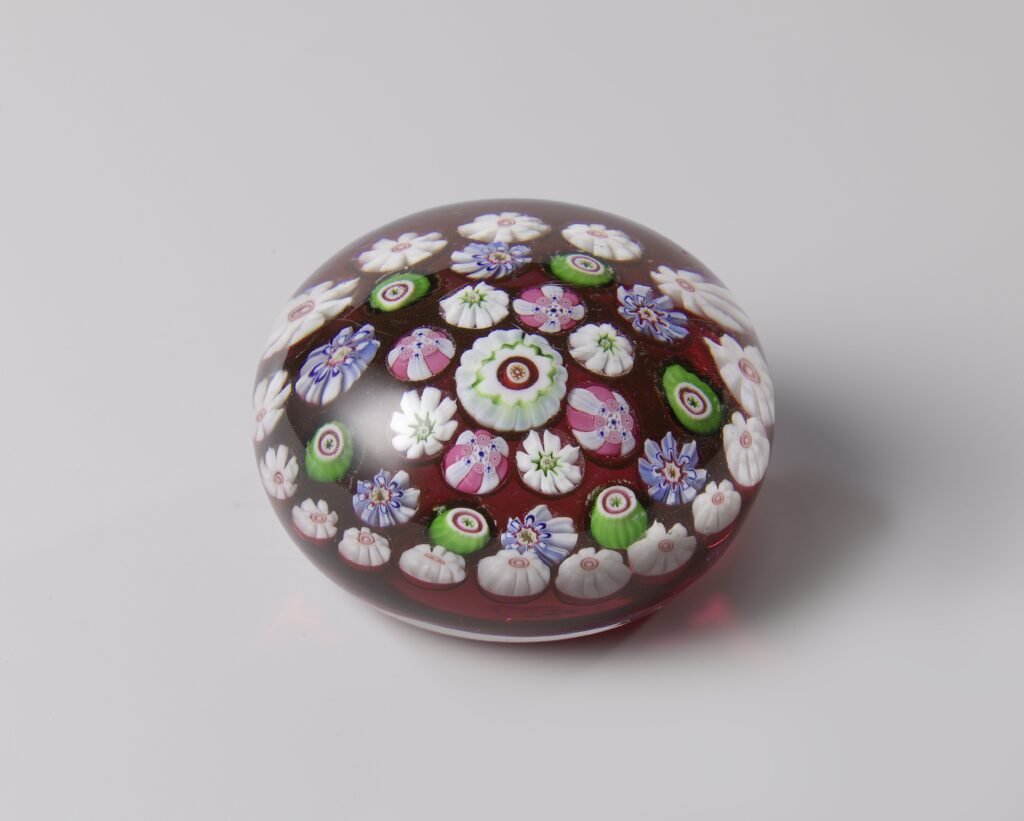
The first thing most people say about a close-packed millefiori weight is that it looks like flowers. The second thing, usually, is to ask how the flowers got in there. Both reactions are the right ones: the technique was named for them. Millefiori is Italian for a thousand flowers, and the illusion is the whole point.
What you are actually looking at
Each apparent flower is the end of a cane: a rod of glass built up in layers, drawn out until the pattern in cross-section is a few millimetres across, then cut. A close-packed weight is a bundle of those cut ends, set together and covered with a dome of clear glass that magnifies them.
The magnification is worth dwelling on. The dome is not decoration. It is a lens, and the maker knew it was a lens, and the arrangement underneath was composed to be seen through it.
The dome is not a cover. It is a lens, and the maker knew it.
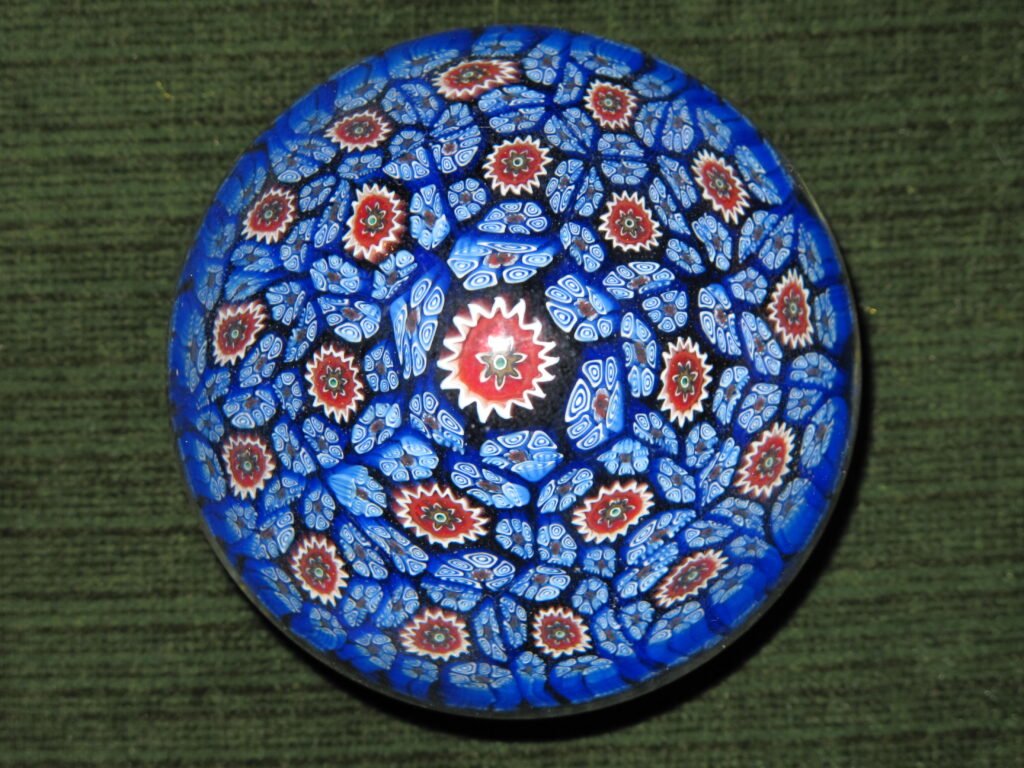
Why the canes matter more than the pattern
Close packing was done by all three of the major French houses during the classic period, so the arrangement alone narrows nothing. What narrows it is the individual canes: which types are present, how well they are made, and whether any of them are peculiar to one factory.
This is where attribution stops being observation and starts being argument, and it is why this catalogue records the difference between a weight that is signed and a weight that merely looks like it belongs somewhere.
Reading it slowly
Turn it. Look at the base as carefully as the top. Count how many distinct cane types you can find before you start repeating yourself. Most people stop at four and are surprised, on a second pass, to reach nine.